

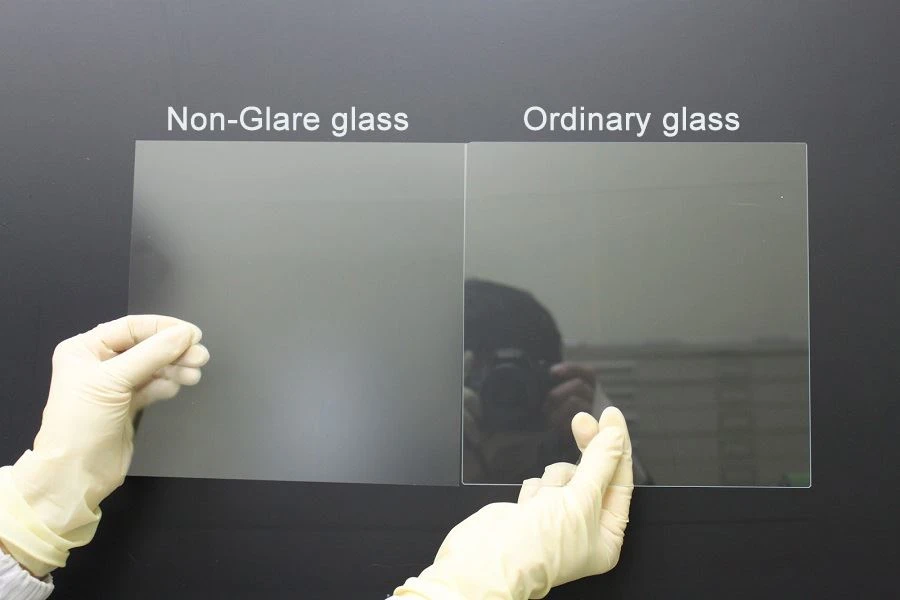
Non-Glare Glass, also called anti-glare glass in English is a kind of glass that is specially processed on the surface of the glass. Its characteristic is to change the reflective surface of the original glass into a matte non-reflective surface. The principle is to subject both sides or one side of high-quality glass sheets to special processing.
Compared with ordinary glass, it has a lower reflectance, and the reflectance of light is reduced from 8 percent to less than 1 percent , thereby reducing the interference of ambient light, improving the clarity of the picture, reducing the reflection of the screen, and making the image clearer and more lifelike. Using technology to create clear and transparent visual effects, allows viewers to experience better sensory vision.
Anti-reflective (AR) glass is optically coated on one or both sides. The anti-reflective coating is usually a dielectric coating and can be applied to the glass in a single layer or multiple layers. When this invisible optical coating is applied to a glass substrate it accomplishes the following:
Riduce la riflessione superficiale
Aumenta la trasmissione della luce
Aumenta la trasmissione e la luminosità del vetro
Aumento della luminosità=migliore definizione del contrasto
Riduce le immagini fantasma/riflessi multipli
Una differenza tra il vetro anti{0}}riflesso e il vetro non{1}}riflesso è la possibilità di personalizzare i rivestimenti per lunghezze d'onda della luce specifiche. I rivestimenti AR possono essere personalizzati per le bande spettrali visibili, UV e/o NIR.
I rivestimenti antiriflesso{0}} possono essere applicati praticamente a qualsiasi supporto di vetro, inclusi Gorilla Glass, Borofloat, vetro float ultra trasparente a basso contenuto di ferro, vetro ultra sottile.

Now that we have explored how both Non-Glare and Anti-reflective glass are produced, let's look at their typical applications. The matrix below can help steer you in the right direction when deciding between Anti-Reflective and Non-Glare Glass.


